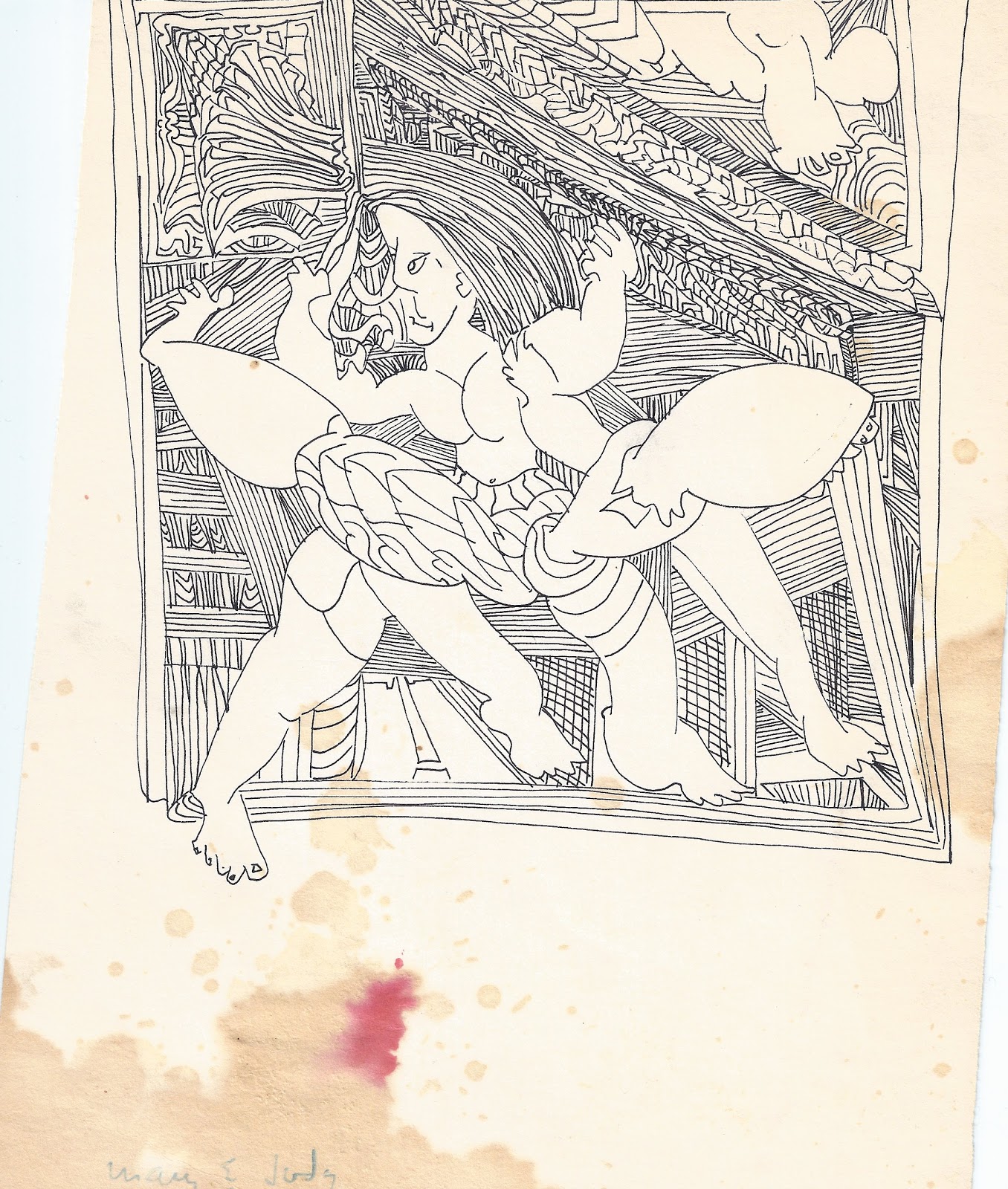
"A snake once flew through the air."


The editors at Open Letters Monthly (OLM) published “That is not Sad, This is Not Funny,” the first result of my haphazard efforts to find out a little more about Paul Hannigan, back in 2007. That essay led directly to the Selected.

OLM is a Boston-based journal (though now its editors work thousands of miles apart); it’s appropriate they would promote Hannigan, who spent most of his life in the Boston area. Today, the new issue is up. The homepage features a pen & ink sketch drawn by Hannigan (click on the image and see how he framed it on a sheet of high quality art paper), and the issue includes a conversation John and I had about the Selected. John’s questions are superb. I struggled to answer them adequately.

John asked, “Where do you see The Problem of Boredom in Paradise fitting into our poetry culture, and what would you like to see?” My answer is a little enigmatic: “When a poet is recovered his recovery reminds that for every name handed down a few are lost. Can we ‘recover’ those hidden from view now? Maybe that’s not possible. Maybe recovery is by nature a project for the generations to follow.”

On my mind as I answered is the ongoing recovery of poetry from the ancient world, how thrilling it is to think another great epic might be found, but also the vast number of literary journals in our world now—the amount of work in journals is as daunting as the desert that buried Ashurbanipal’s library for thousands of years.

I need more time.

The Next Big Thing


[The following conforms to the chain-letter ominously known as The Next Big Thing.] 

1. What is the title of your new book?

The Problem of Boredom in Paradise (Selected Poems by Paul Hannigan).

2. Who is the publisher of your book?

Flim Forum Press. Originally, Pressed Wafer offered me the chance to do a selected. It was to be no more that 100 pages, which at the time seemed reasonable, since I’d yet to uncover Hannigan’s unpublished ms. The Higher Slum, or the hundreds of unpublished poems, or the unfinished novels, etc. Pressed Wafer lost interest in my participation because I was slow to produce a ms. I suggested the project to Matthew, even though Hannigan is not an obvious Flim Forum poet, and expected to be turned down. Matthew asked me if I thought Hannigan’s poetry was good and the project worth doing. I said yes. So he said yes. An act of faith I appreciate.

3. What genre does your book fall under?

Poetry. Sub-genre, the rescue-volume. That is, from obscurity. Hannigan has been out of print since the late 1970s.

4. What is one sentence from your book?

"When, as occasionally happened, a tribesman burst into tears at his own joke, his peers would roar in rebuke: That is not sad; this is not funny." [from “The Bush”]

5. Where did the idea for the book come from?

From Paul Hannigan. (I write about the origin of the selected in my introduction, but, without repeating myself, I can offer a less flip answer than “Paul Hannigan.” When I started the Hannigan project, I did not imagine I would edit a selected; I just wanted to know a little more about who he was. The idea of doing a book gradually grew from that research.)

6. How long did it take you to write the first draft of your manuscript?

Not exactly applicable, however—I began typing up poems  (with the help of my wife Amy and the choreographer Nina Joly) that might end up in a book in 2007, shortly after I published an article about Hannigan in Open Letters Monthly; his widow, Caroline Banks, read the article and gave me the go-ahead (and helped fund a research trip to Georgia, where his papers reside).

7. What are your influences for this book?

When writing my introduction, I specifically thought of Michel de Montaigne. John Cotter offered suggestions that helped me to think about the book. Otherwise, and obviously, what of Hannigan’s spirit I could pick up from his corpus, so-to-speak.

8. What else might pique the reader’s interest?

The March issue of OpenLetters Monthly, our Paul Hannigan blog, and the article I wrote for OLM back in 2007.

"Nowadays, the people you see at the Grolier are..."


Elsa Dorfman, in 1968, wrote a piece for the Boston Globe about the Grolier, an all-poetry bookshop in Harvard Square, Cambridge. The shop’s still there. Any poet who ever set foot inside comes out mythologizing the place. Poets young in the 1960s – early 70s especially mythologize Gordon Cairnie, its original proprietor, who opened the shop in the 1920s. He’s either a curmudgeon or a generous true friend of poetry. Dorfman chose to begin her article by portraying him as the latter:
I do remember going in once when I was a sophomore at Tufts. I opened the door and asked the old man sitting on the couch if he had Steppenwolf. No, he didn’t, he replied flatly. Did he know where I could find it? No. He had no idea at all.
I think it’s fair to say he was being an ass, but being rude is often romanticized by artists, and so it was by Dorfman and many Grolier regulars. She was smart enough to know this, and wrote, “Gordon’s irascibility isn’t an act, but it’s only part of the story. There’s also his legendary generosity and kindness.” (Probably just a thoughtless use of cliché, but note “legendary.”)

 “Nowadays,” Dorfman wrote, “the people you see at the Grolier are…” and Paul Hannigan is in the list that follows. She mentions that “[Bill] Ferguson printed ‘The Other End of the Couch,’ a collection of poems by Gordon’s friends.” The title is a reference to the red couch Gordon had in the store, a less enduring bit of the myth. (I’ve not seen the collection—I don’t know if it includes a poem by Hannigan. Let me know if you know.)

Louisa Solano took over the Grolier in 1974. She is the proprietor my generation talks about, often with little affection, though she kept the place going, and was kind to me when I came in ignorant, asking after poets who were names-only to me, but were people she knew. My sister used to go in there and buy me presents. Solano retired in 2004. I’m working with the current proprietors to set up some kind of reading with them to celebrate the Hannigan selected and its Cambridge roots. When I've news you'll know.

[Photograph by Damien Weber, sign for A Sing Economy reading with the Grolier, February 2008.]